
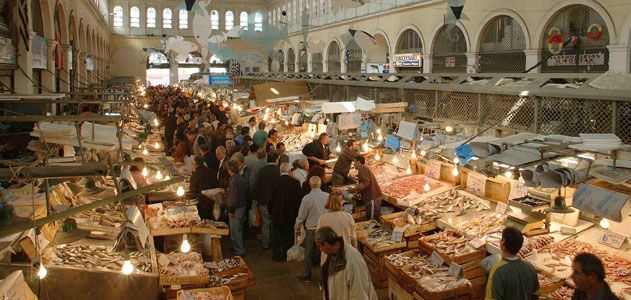
The first thing I noticed inside the Athens Central Market was not the abundance.
It was the noise.
Not the kind of noise that announces itself as chaos, but the layered kind—metal against stone, water hitting tile, the rhythm of knives meeting bone. A sound system of labor, not performance.
I’ve been in markets before, but I rarely enter them as a traveler anymore. I enter them the way I enter kitchens: watching how things move, how they are cut, how they are handled, how nothing is wasted in the act of making.
In Athens, the meat hall comes before anything else makes sense.
Carcasses hang in quiet rows under fluorescent light, not staged for beauty, but for use. There is no attempt to soften what food is here. It is still closer to animal than product, and the people working beneath it move with the kind of familiarity that only repetition creates.
What struck me was not the sight, but the lack of hesitation.
There is a certain confidence in places where nothing is hidden.
Beyond the meat, the rhythm shifts.
Fish lay in crushed ice—eyes still clear, scales catching light like small pieces of glass. Men calling out prices without looking up. A transaction language that requires no decoration. Everything here is immediate: seen, assessed, and moved.
This is what most travelers miss when they say they’ve “experienced” a food culture.
They see the plated version.
They rarely see the decision-making before it becomes edible.
I found myself slowing down—not because I wanted to take it in, but because I needed to understand how it functioned.
In kitchens, I’ve always believed that you learn more from timing than from a recipe.
The same is true here.
How long does a fish sit before it is choosen.
How quickly a cut is made once it is selected.
How little conversation exists around decisions that elsewhere would be overexplained.
At one stall, I watched a man break down a fish with no ceremony at all. His knife never paused. There was no performance in it—only accuracy. The kind of movement that comes from not thinking about movement anymore.
That, more than anything else, told me where I was.
Not in a market as a visitor.
But inside a system that has no interest in explaining itself.
Further in, the air changes again. Olive oil, herbs, dried fruit, spices—smells that begin to soften the earlier sharpness. Here, language returns. People talk longer. They offer tastes. They explain origin, variety, and harvest.
At one olive stall, I paused longer than I intended.
The man behind the counter noticed—not with impatience, but with the kind of attention people in markets develop when they’ve spent years reading hesitation.
He slid a small cup of oil toward me without asking.
“Try,” he said simply.
It was not an invitation so much as a gesture of certainty.
The oil was greener than I expected, slightly bitter at first, then softening as it moved across the tongue. I must have lingered in my reaction, because he nodded once, as if confirming something I hadn’t yet said out loud.
“From here,” he added, tapping the counter lightly, not the bottle. “Not far.”
There was no explanation beyond that.
No story about awards or process or heritage.
Just the distance made it small enough to taste.
Even here, though, I noticed something consistent.
The best vendors did not oversell.
They let the food do most of the speaking.
And that restraint—more than any dish or ingredient—is what stayed with me after I left.
Walking out, I realized I hadn’t been looking for things to eat.
I had been watching how food is made.
There is a difference.
One is consumption.
The other is understanding.
And markets, at least the ones worth remembering, exist somewhere between the two.


Leave a comment